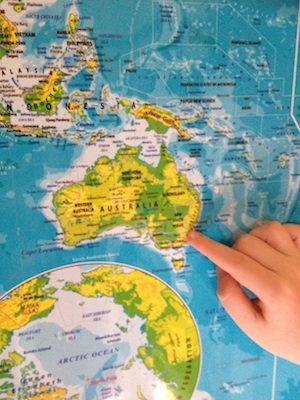
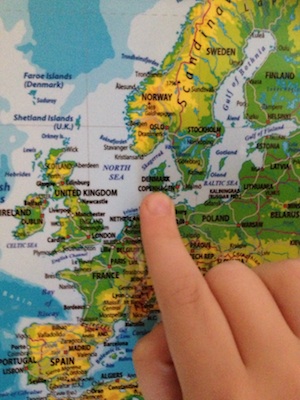
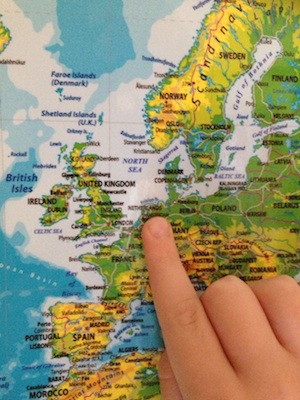
Just testing our new Apple camera connection kit so we can upload photos directly from the iPhone or camera to an iPad without needing wifi and then use them to write posts. We’ve just discovered the app “Aviary” to crop, edit, fancy up photos. Combined with the WordPress app on the iPad, blogging on the go looks more do-able!
Category Archives: Before our trip
Carry on only?
I just received an interesting email from Cindy Heazlit of LadyLight Travel. She writes:
Hi Amanda,
I noticed your posts on WordPress. Have you considered going carry on (hand luggage) only in your travels? It will make your lives easier, especially if you are taking public transportation. If you would like to try it I recommend onebag.com as the very best site. I’ve linked to a great article on a family that did it:
http://www.bigredkitchen.com/2012/01/the-almost-no-bag-challenge-how-to-live-out-of-one-bag-for-21-days-in-europe/
Regards,
Cindy Heazlit
LadyLightTravel
To be honest, I didn’t think of taking just carry on for this trip or any recent trips. Oliver and I will be taking one carry on backpack each and one medium sized wheelie suitcase each (check in). I don’t think just carry on would suit us for at least four reasons: (1) I’ll be attending two academic conferences, including one where I will be a Keynote Speaker, so I will need to bring dressy clothes as well as casual clothes; (2) conferences usually involve all day sessions and then after hours (work) socialising, so not much time for washing out and drying clothes; (3) I worry about the weight limits of carry ons; on my most recent international trip the limit was 7 kg; and (4) I need somewhere to put of all the shopping Oliver and I intend to do at Legoland!
In the years I have been travelling to conferences I have noticed some interesting changes in the luggage people carry. In the US, people used to carry on enormous amounts of luggage with inevitable tussles over overhead bin space. But on a trip to Seattle, Minneapolis, and San Francisco late last year I noticed that restrictions were now in place for the amount of carry on.
But I’ve always been interested in minimising the amount of luggage and being a more efficient packer. And I love the idea of a capsule wardrobe, which Cindy covers in detail on her website. People who know me know that I wear a lot of navy, which is a good colour to build a capsule wardrobe around.
Anyway, thanks for the suggestion Cindy. Visit Cindy’s blog to read more about one bag travelling!
A note for kids about exchange rates
In his post, Oliver listed the currency and exchange rates for each country we will visit.
Currency is the kind or system of money used in each country in the world. When we travel to other countries we need to use their currency; we can’t use our Australian dollars. So in England we will use pound sterling. You write it like this, £5 (and not like this, $5). In Denmark we will use Danish krone, and in The Netherlands we will use the euro (before 2002 they used the Dutch guilder). These currencies can look quite different to ours. For instance, in Australia our $2 coins are smaller than our $1 coins, but in England their £2 coins are bigger than their £1 coins. In Australia our notes are different colours and sizes for the different denominations ($5, $10, $20, $50, $100), but in the USA all of their notes are green and about the same size. So it’s easy to get confused and give the wrong money.
To get pounds and kroner and euros for our trip we need to buy them with Australian dollars. An exchange rate “between two currencies is the rate at which one currency will be exchanged for another”. For our trip, we are interested in the exchange rates for pounds, kroner and euros. In other words, how many Australian cents or dollars will it cost us to buy 1 pound, 1 krone or 1 euro?
- $1.57 in Australian money to get 1 pound
- 18 cents in Australian money to get 1 krone
- $1.34 in Australian money to get 1 euro
So if Oliver saves up $100 in pocket money for our trip, he can exchange it for 64 pounds, 557 kroner, or 75 euros. You can try doing your own currency conversions here.
When Oliver’s dad and I first travelled to England about 15 years ago, the exchange rate was more like 3 to 1. It would cost $3 in Australian money to get 1 pound. It was very expensive to travel there. But the exchange rate has improved a lot.
Another important thing to know about is the cost of living. A packet of hot chips at our local chicken shop costs $2. If a packet of hot chips also costs £2 in London and the exchange rate is 3 to 1, those chips cost us $6 in Australian money. Pretty expensive chips. But if the exchange rate is 1.5 to 1, as it is now, then those chips are only about $3 in Australian money. So not too bad. When you are travelling you have to keep your eye on the exchange rate and the cost of the things you are buying. When Oliver and I are in London, for example, we will be able to multiply by 1.5 the cost of things we want to buy to work out if it is cheaper than Australia or much more expensive.
This is not too tricky when the rate of the Australian dollar and the foreign currency is pretty close (like now for the US dollar, where the exchange rate is almost 1 to 1; it costs about 1 Australian dollar to buy 1 US dollar). But it gets more challenging with a currency like the Danish krone.
Right now it costs 18 Australian cents to buy 1 Danish krone. So those $2 chips in Australian money would cost 11 Danish kroner if the cost of living is about the same in Australia and Denmark. You might think “whoa, $11 for chips”. But you have to remember that each krone is worth less than an Australian 20 cent piece. 11 x 20 cents is $2.20 in Australian money. But maybe chips in Denmark cost 15 kroner because the cost of living is higher there. How much is that in Australian money?
15 (kroner) x 18 cents (the current exchange rate) = $2.70 in Australian money. So a bit more expensive than here at home but not too bad.
As you can see, Oliver and I will have lots of opportunities to practice our maths skills while we travel.
18 days to go, my itinerary by Oliver and Siri
Oliver and Siri (on his iPad mini) did some research about our travel destinations:
What is an itinerary?
According to http://www.thefreedictionary.com, an itinerary is “a route or proposed route of a journey”.
Here is where Mum and I are going:
London, England
- Where is it: England is part of the United Kingdom of Great Britain and Northern Ireland and lies in North West Europe
- Distance from Australia: 16,990 kms
- Hours to get there (from Australia): 21-22 hours
- Language/s spoken: British English
- Currency and exchange rate: British pounds, £1 = $1.57 in Australian money
- Size (relative to Australia): 130,395 km2; Australia is 7,692,024 km2, so England is less than 2% of the size of Australia
- Population: 51 million people; Australia’s population is 22.3 million, so England has twice as many people in less than 2% of the area of Australia!
- What I might eat: fish and chips
Aarhus, Denmark
- Where is it: Denmark is one of the four Nordic countries and lies in Northern Europe
- Distance from Australia: 16,160 kms
- Language/s spoken: Danish (many people also speak English)
- Currency and exchange rate: Danish krone, DKK1 = 18 cents in Australian money
- Size (relative to Australia): 43,094 km2, so Denmark is less than 0.5% of the size of Australia
- Population: 5.5 million people, so Denmark has 25% of the population of Australia but in only 0.5% of the area of Australia
- What I might eat: Meatballs
- Where is it: The Netherlands is in Europe and borders Germany
- Distance from Australia: 16,690 km
- Language/s spoken: Dutch and English
- Currency and exchange rate: Euros, €1 = $1.34 in Australian money
- Size (relative to Australia): 41,543 km2, so The Netherlands is less than 0.5% of the size of Australia
- Population: 16.6 million people, so The Netherlands has 75% of the population of Australia but in only 0.5% of the area of Australia!
- What I might eat: Bread, cheese and ham
19 days to go, some favourite books about …
… journeys, travel, London, England, Denmark, The Netherlands?
Amanda recommends:
1. Snobs by Julian Fellowes. Fellowes is best known as the creator and writer of Downton Abbey but he is also an accomplished novelist. Snobs was his first novel. Set in London and rural England, it tells the story of beautiful Edith Lavery who marries, but not for love, a wealthy English aristocrat. If you like Downton Abbey, you’ll enjoy this.
2. Letters from London by Julian Barnes. Barnes was the London Correspondent to the New Yorker for four years from 1990 to 1994. This book is a collection of his published essays from that period. For instance, in an essay called “Froggy, froggy, froggy” he describes the opening of the Channel Tunnel in 1994, which forever linked “old enemies” Britain and France (unfortunately we won’t have time to ride the Channel Tunnel on this trip). My favourite essay is the cautionary tale of the fall of Lloyds of London. A wonderful book.
3. The Stages: A Novel by Thom Satterlee. I mentioned this book in a previous post. It tells the story of Daniel Peters, a man with Asperger’s who lives in Copenhagen and works as a translator at the Kierkegaard Research Center. The novel starts with the murder of his boss and former girlfriend and the theft of a newly discovered Kierkegaard manuscript. Daniel is suspected and joints the hunt for the real murderer, although his Asperger’s makes it difficult for him to interpret the behaviour of others and to deal with the twists and turns of the murder mystery. The book paints a loving picture of Copenhagen and the Danish people, as well as a realistic portrait of living a life with Asperger’s.
Oliver recommends:
4. The Hobbit or There and Back Again by Oxford Professor, J.R.R. Tolkien. The quintessential travel story. A life changing journey. Oliver and I have been reading The Hobbit and we recently watched the first instalment of the three-part movie. We don’t expect our journey to be as eventful as Bilbo’s, although Oliver is willing to give Midsummer Night’s Dream a whirl at Shakespeare’s Globe Theatre London if he is likely to see elves and dwarves!
5. Gangsta Granny by David Walliams. You might know Walliams as one half of the Little
Britain team. This book is set in London. It tells the story of Ben who is sent to stay at his Granny’s house. He thinks she is really boring until he finds out that she used to be an international jewel thief and all her life she has plotted to steal the Crown Jewels from the Tower of London. Now that Ben is staying, she has the help she needs to do it. Oliver loved this book; it’s the reason we are visiting the Tower of London during our visit.
Do you have some favourite books about journeys and travel? Or favourite books set in or about any of the places we will visit?
Just so we are clear …
Copenhagen is in Denmark and Amsterdam is in The Netherlands!!
Now that I am no longer confusing the two and have fixed a few of our posts, I am sure that Oliver and I will easily get our Schengen visas!
Actually, Australians don’t need visas for England, Denmark or The Netherlands if they are visiting for less than 90 days, which is handy. But it helps to be clear on the geography!
I never picked geography questions in Trivial Pursuit. I’ll have to leave the maps to Oliver. But Copenhagen is stuck in my brain ever since I read a terrific book about the city, Søren Kierkegaard, and a murder mystery. It’s called The Stages by Thom Satterlee. I heartily recommend it. Looks like the author will be in Aarhus just before Oliver and I. What a small world!
Where would you go in London?
As you might have read below, our first destination is London. We’ll be based in Paddington.
Where are your favourite places to go? Where have you been in London that an 8 year old boy would love?
Click “leave a reply” to add your suggestions. Thanks!
20 days to go, the packing list
Amanda says:
I am a big believer in the “trial pack”; laying out all your stuff and checking that it fits in your luggage before departure day. I’m also a big believer in a suitcase with a “gusset” zip so you can undo it when your bag gets too full and get some extra room. That way you can hit the shops and not worry about fitting all your purchases into the suitcase or trying to smuggle it home in your overweight hand luggage (and breaking your back in the process).
I like to be organised for my flights. I do not like to pack at the last minute. So already I am starting to think about what we will be taking and what I will be packing it in.
So in that spirit, here are my top 5 items to pack (apart from passport and money):
- my Kindle and cover with integrated light, which not only saves space in my carry on bag but saves me money when I’m browsing the airport bookstores (the cover with light is especially good because I can read on the plane without the overhead light on)
- noise cancelling headphones for the plane
- some of these mesh bags to store my plugs and cables and some of these packing cubes to sort the clothes in my bag
- a change of clothes in my carry on bag in case my luggage doesn’t make it (touch wood it doesn’t happen this trip) or just to freshen up after 24+ hours in transit
- some comfy clothes for the hotel room and comfy shoes for all the walking we will do
I am a bit of a Crumpler luggage fan boy. For this trip I have a new Crumpler backpack as my carry on so I have hands free to help Oliver with his luggage. Here’s a picture …
Oliver says:
My top five items to pack are:
- my iPad mini, which I got as an early birthday present for this trip
- sunglasses
- a camera
- my travel diary (something like this)
- my guide books, including this one for London
What are your must pack items?
This is my little sister Louisa.
She won’t be coming to Europe with us. She really likes plane rides. She likes having her own seat and she would love having her own tv and games system. But she probably wouldn’t be very good at sitting quietly and waiting for Mum while she is doing her conference stuff. She can maybe go with Mum another time.
So she’ll be reading this blog at home with Dad.
21 days to go, Amanda says
In just 3 weeks Oliver and I are flying to Europe together.
For the past 20 years, most years, I have flown around the world to academic conferences or to visit my collaborators at their universities. These trips have taken me all throughout the USA and Canada, to the UK many times, to France, Spain and Sweden, to New Zealand and to Norfolk Island. I am lucky to have had such great opportunities to see the world.
This June, for the first time ever, Oliver is coming with me. He has never been overseas and I have never taken a family member on the conference circuit before. So something new and exciting for both of us.
I am looking forward to sharing one of my favourite cities with him: London. We will be in London for 4 1/2 days, visiting with Professor Martin Conway at City University London. Martin is an expert on autobiographical memory and does some very cool work advising law courts and legal practitioners about the reliability of memory. He also collaborates with artists and actors exploring the nature of remembering.
I have visited London maybe 10 times and have some favourite places to take Oliver: the British Museum to see the Egyptian collection, a river boat cruise on the Thames, and Hamley’s Toy Shop in Regent Street. We also plan to visit places I have never seen, such as The Tower of London, Windsor Castle, Legoland Windsor, the Churchill War Rooms and Chelsea Football Stadium. And of course we’ll ride the Underground and some red double-decker buses.
Our next stop is Aarhus in Denmark, where we will be for a week. I have not been to Denmark but my friend and colleague, Celia, lived and worked there for a year. She said it is wonderful. I have been invited to a specialist memory conference at Con Amore — the Centre on Autobiographical Memory Research — an international centre of excellence for memory research. Quite a few members of my Macquarie University Memory team will present at the conference also. Oliver and I have been invited to a reception at Town Hall where we hope to meet the Mayor of Aarhus. After the conference Oliver and I plan to go to the original Legoland!
Our final stop is Rotterdam in The Netherlands where we will be for 4 1/2 days. We will fly from Aarhus to Copenhagen, then Copenhagen to Amsterdam and then take a train to Rotterdam. Again, I have never been to The Netherlands. We are there for the 10th Biennial Conference of the Society for Applied Research in Memory and Cognition. Almost all of our Macquarie Memory team will be there: Adam, Aline, Amanda, Doris, John, Misia, Penny, Rochelle, as well as good friends and collaborators, such as Suparna Rajaram from Stony Brook University, New York. I am giving a short paper in a pre-conference workshop on Social Aspects of Memory, and chairing and presenting in a symposium on social scaffolding of memory in the main program. I’m looking forward to seeing lots of my research friends from around the world. During the conference, Oliver will explore Rotterdam with the fabulous Nina McIlwain.
We then will head home. We are flying to Europe and back on some really big planes (the new, A380-800 from Sydney to London and back) and some really little ones (from Aarhus to Copenhagen). Oliver is looking forward to the inflight entertainment system, but I will let him write about that.
It should be an amazing trip. Two weeks, just Oliver and I and a whole new world.