Category Archives: Planning

6 days to go, tips for on the move

Louisa woke me very early today so I’ve made good progress on my last big talk. Just one section to rewrite and then I’ll practice Tuesday morning (come and sit in and give me feedback if you are in the vicinity; Tuesday 11 June at 9.30am on Level 3 of the Australian Hearing Hub, Macquarie University). I’m a little worried that my talk is way too long but hopefully it’s interesting. We’ll see. In the 20 years I have been going to conferences I have seen so many different kinds of Keynote Talks: talks that are light on data but inspire you with a big picture; talks that are all data (lots and lots and lots of data) and not so many grand ideas; talks that are quite impersonal and objective; and talks that reflect the speaker’s journey and passions as much as their work.

What’s the best (kind of) Keynote Talk you’ve seen?

Since I’ve made good progress on the talk and am likely to have it completely drafted for my practice on Tuesday morning, I am happy to think about the packing and planning again. So it was a case of good timing today when I received an email from my friend, Karen G (hi Karen!). She sent me a few tips for London sightseeing: the Yeoman Warder’s Tour in the Tower of London and audio tours for kids in the British Museum. I love audio tours! So much better than finding your own way to the best exhibits and reading little plaques! She also sent me some tips about eating cheaply in London: Boots pharmacy, Budgen’s supermarket and Pret a Manger. I knew about the first and the third but not the second. Great options for fresh sandwiches, cut fruit, healthy snacks and inexpensive drinks.

Finally, Karen warned me that in the last few months there has been a huge increase in the number of iPhones and iPads stolen in London from people using them while out and about on the street and in cafes. I presume by snatch and run or pick pocketing? As you might have read, we gave Oliver a new iPad mini as an early birthday present for this trip. The last thing we want is for it to be stolen or lost. And as I’ve prepared for our trip I’ve tossed up whether to use travel apps (on my iPhone or Oliver’s iPad mini) to navigate or just use an old-fashioned guidebook. I had a well-loved London Eyewitness Travel guide, which one of my brothers never returned after borrowing it for a trip. In the end I decided to buy a copy of the Lonely Planet’s new, anniversary London guidebook (on sale for $20 at Myer last week). Although I am almost entirely digital in my workflow (on my Mac Book and iPad) and reading (with a Kindle), I will still prefer to pop this in our day pack as we wander around and not risk the iPads being stolen or lost.

Our other (mild) defence against theft is to disguise the iPads. I really love iPad DODOCases. They are hand-made in San Francisco by a traditional book binding company and make your iPad look like a hard cover book. Hopefully less attractive to thieves?! Here is a picture of Oliver’s new cover — outside and inside — and my cover. They are really sturdy and beautifully made.

My last “on the move” tip for today is the Cash Passport. Normally when I travel I take a small amount of the local currency and then withdraw money at ATMs at my destination. I’ve run into a couple of problems with this strategy: not being able to find an ATM when I need it or the ATM not spitting out the cash but deducting my balance anyway. My bank also charges a hefty fee for the cash advance and the exchange rate is pretty lousy. This time I am using a multi-currency Travelex Cash Passport. You buy it at a Travelex branch or online before you leave and load it with amounts of the currencies you need. So I have one loaded with pounds and with euros. Unfortunately I can’t load kroners on it. You get two cards (with different pins) in case you lose one or one is stolen. You can check your balance online and reload the card if you need to. Most importantly, the Cash Passport is partnered with MasterCard, so you can use it at any ATM or point of sale that accepts MasterCard. I bought mine on Friday and locked in the exchange rates (which are falling for the Australian dollar).

So we are nearly all set. In these last few days we’ll be picking up dry cleaning, washing clothes we want to take (and wearing all our daggy clothes!), packing, getting together paperwork, backing stuff up on Dropbox, etc etc.

Any last-minute (or not really that last-minute compared to when other people pack) tips for us?

1 week to go, the conference Grand Slam!

So Oliver and I will be boarding our plane almost exactly a week from now.

I was going to post about conferences: what they are, what happens at them. But I haven’t had time to finish it amidst writing the three talks I’ll be giving at my two conferences. I’ve finished two and I am working on the third talk. It’s the longest talk — the 45 minute keynote — and I want to make a splash with it.

For this talk I am using Prezi instead of Powerpoint. Prezi is a relatively new online presentation platform. Whereas Powerpoint is very linear in the way you present information, Prezi is more visual. It’s hard to explain without seeing it so check out a simple presentation that Oliver wrote in Year 2 (here).

Oliver's Prezi about Anzac Day

Oliver’s Prezi about Anzac Day

Prezi is working well for this keynote talk because I’m hoping to take the audience on a bit of journey from the early days of our collective memory work until now, and the big, new questions that we are grappling with. Prezi lets you map that journey visually. Perhaps I will post the link to my Prezi after I have written and given it.

Meanwhile, I am writing it! The last few days I have tried to focus just on this task, staying up late and getting up early to finish it before we fly. While writing I’ve managed to catch a bit of the French Open. I have lots of happy memories of writing grants until all hours while watching either the Australian Open (which falls during peak ARC grant writing time) or Wimbledon. I am a big tennis fan.

One of my happiest travel days ever was during 6 weeks I spent in London in 2001. I was visiting at University College London and attending the Annual Meeting of the British Psychological Society and then flying to Valencia, Spain for the 3rd International Conference on Memory. On this particular day — a warm, sunny London summer day in June — I got up early and caught a train out to Wimbledon. I joined the queue for a ticket for the outside courts. The queue was 3 hours long but there was lots of entertainment along the way; the English really know how to queue! Once inside I sat right beside one of the outside courts and watched Frenchman Arnaud Clement play. Later I watched some doubles. It was a magical day. Sun. Pimms. Tennis. Gift shop. Too bad that Oliver and I will be a little early in London for the 2013 Championships.

I have often talked about trying for a conference Grand Slam. But it is tricky finding conferences in Melbourne, Paris, London and New York to coincide with the Australian Open, French Open, Wimbeldon and US Open. I’ve already been to Wimbledon, as you’ve heard, and to the Australian Open (a few times). I have a great new collaborator and colleague in New York, Professor Suparna Rajaram, who is just as keen on the tennis as I am. Now to find a French collaborator! Not sure if I could complete the conference Grand Slam in one year but it is always good to have a goal in life!

English: Wimbledon Championships

English: Wimbledon Championships (Photo credit: Wikipedia)

Today I’ve finished writing two of my three conference talks, except for some fiddly error bars on the graphs for Talk 2. Here’s a preview …  Just one more (big) talk to write now before we fly.

Talk 1: A five minute special for the Social Aspects of Memory Pre-Conference Workshop in Rotterdam. I don’t think I’ve ever given a five minute talk before. It’s short. People who know me know that I have much more to say than five minutes worth.

The 5 minute talk for the Social Aspects of Memory Pre-Conference Workshop in Rotterdam

The 5 minute talk for the Social Aspects of Memory Pre-Conference Workshop in Rotterdam

Talk 2: A 12 minute talk in a symposium on Scaffolding Memory Across the Lifespan in the main SARMAC Conference program in Rotterdam. My talk is one of five themed talks so the trick is to make my talk relevant to the overall theme of the session as well as pick up on ideas that my colleagues might say in their papers (without being too repetitive). My talk is number four out of five, which means I will shallow breathe through three before it is my turn.

The 12 minute talk for our SARMAC symposium on Scaffolding Memory Across the Lifespan

The 12 minute talk for our SARMAC symposium on Scaffolding Memory Across the Lifespan

A note for kids about exchange rates

In his post, Oliver listed the currency and exchange rates for each country we will visit.

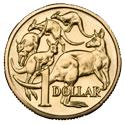
Currency is the kind or system of money used in each country in the world. When we travel to other countries we need to use their currency; we can’t use our Australian dollars. So in England we will use pound sterling. You write it like this, £5 (and not like this, $5). In Denmark we will use Danish krone, and in The Netherlands we will use the euro (before 2002 they used the Dutch guilder). These currencies can look quite different to ours. For instance, in Australia our $2 coins are smaller than our $1 coins, but in England their £2 coins are bigger than their £1 coins. In Australia our notes are different colours and sizes for the different denominations ($5, $10, $20, $50, $100), but in the USA all of their notes are green and about the same size. So it’s easy to get confused and give the wrong money.Australian_$1_Coin

To get pounds and kroner and euros for our trip we need to buy them with Australian dollars. An exchange rate “between two currencies is the rate at which one currency will be exchanged for another”. For our trip, we are interested in the exchange rates for pounds, kroner and euros. In other words, how many Australian cents or dollars will it cost us to buy 1 pound, 1 krone or 1 euro?

These exchange rates go up and down. But now it costs:
  • $1.57 in Australian money to get 1 pound
  • 18 cents in Australian money to get 1 krone
  • $1.34 in Australian money to get 1 euro

So if Oliver saves up $100 in pocket money for our trip, he can exchange it for 64 pounds, 557 kroner, or 75 euros. You can try doing your own currency conversions here.

When Oliver’s dad and I first travelled to England about 15 years ago, the exchange rate was more like 3 to 1. It would cost $3 in Australian money to get 1 pound. It was very expensive to travel there. But the exchange rate has improved a lot.

Another important thing to know about is the cost of living. A packet of hot chips at our local chicken shop costs $2. If a packet of hot chips also costs £2 in London and the exchange rate is 3 to 1, those chips cost us $6 in Australian money. Pretty expensive chips. But if the exchange rate is 1.5 to 1, as it is now, then those chips are only about $3 in Australian money. So not too bad. When you are travelling you have to keep your eye on the exchange rate and the cost of the things you are buying. When Oliver and I are in London, for example, we will be able to multiply by 1.5 the cost of things we want to buy to work out if it is cheaper than Australia or much more expensive.

This is not too tricky when the rate of the Australian dollar and the foreign currency is pretty close (like now for the US dollar, where the exchange rate is almost 1 to 1; it costs about 1 Australian dollar to buy 1 US dollar). But it gets more challenging with a currency like the Danish krone.

Right now it costs 18 Australian cents to buy 1 Danish krone. So those $2 chips in Australian money would cost 11 Danish kroner if the cost of living is about the same in Australia and Denmark. You might think “whoa, $11 for chips”. But you have to remember that each krone is  worth less than an Australian 20 cent piece. 11 x 20 cents is $2.20 in Australian money. But maybe chips in Denmark cost 15 kroner because the cost of living is higher there. How much is that in Australian money?

15 (kroner) x 18 cents (the current exchange rate) = $2.70 in Australian money. So a bit more expensive than here at home but not too bad.

As you can see, Oliver and I will have lots of opportunities to practice our maths skills while we travel.

18 days to go, my itinerary by Oliver and Siri

australia map3

Oliver and Siri (on his iPad mini) did some research about our travel destinations:

What is an itinerary?

According to http://www.thefreedictionary.com, an itinerary is “a route or proposed route of a journey”.

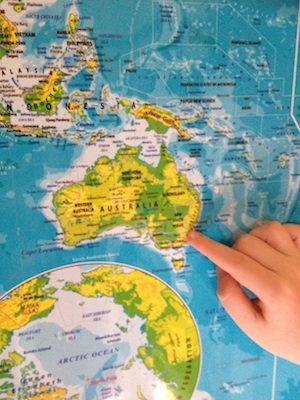
Here is where Mum and I are going:

London, England

london map3

  • Where is it: England is part of the United Kingdom of Great Britain and Northern Ireland and lies in North West Europe
  • Distance from Australia: 16,990 kms
  • Hours to get there (from Australia): 21-22 hours
  • Language/s spoken: British English
  • Currency and exchange rate: British pounds, £1 = $1.57 in Australian money
  • Size (relative to Australia): 130,395 km2; Australia is 7,692,024 km2, so England is less than 2% of the size of Australia
  • Population: 51 million people; Australia’s population is 22.3 million, so England has twice as many people in less than 2% of the area of Australia!
  • What I might eat: fish and chips

Aarhus, Denmark

denmark map3

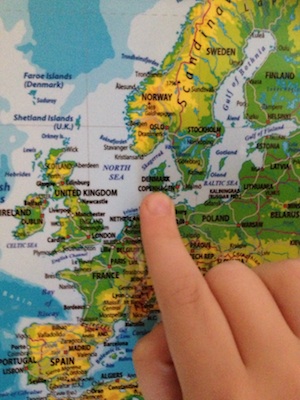
  • Where is it: Denmark is one of the four Nordic countries and lies in Northern Europe
  • Distance from Australia: 16,160 kms
  • Language/s spoken: Danish (many people also speak English)
  • Currency and exchange rate: Danish krone, DKK1 = 18 cents in Australian money
  • Size (relative to Australia): 43,094 km2, so Denmark is less than 0.5% of the size of Australia
  • Population: 5.5 million people, so Denmark has 25% of the population of Australia but in only 0.5% of the area of Australia
  • What I might eat: Meatballs
Amsterdam and Rotterdam, The Netherlands
netherlands map3
  • Where is it: The Netherlands is in Europe and borders Germany
  • Distance from Australia: 16,690 km
  • Language/s spoken: Dutch and English
  • Currency and exchange rate: Euros, €1 = $1.34 in Australian money
  • Size (relative to Australia): 41,543 km2, so The Netherlands is less than 0.5% of the size of Australia
  • Population: 16.6 million people, so The Netherlands has 75% of the population of Australia but in only 0.5% of the area of Australia!
  • What I might eat: Bread, cheese and ham

Just so we are clear …

Z kierkegaard

Z kierkegaard (Photo credit: Wikipedia)

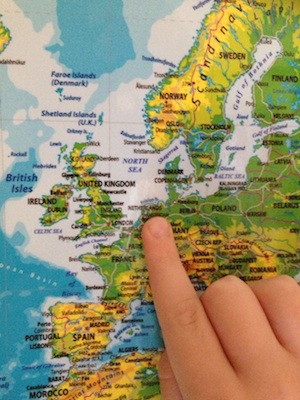
Copenhagen is in Denmark and Amsterdam is in The Netherlands!!

Now that I am no longer confusing the two and have fixed a few of our posts, I am sure that Oliver and I will easily get our Schengen visas!

Actually, Australians don’t need visas for England, Denmark or The Netherlands if they are visiting for less than 90 days, which is handy. But it helps to be clear on the geography!

I never picked geography questions in Trivial Pursuit. I’ll have to leave the maps to Oliver. But Copenhagen is stuck in my brain ever since I read a terrific book about the city, Søren Kierkegaard, and a murder mystery. It’s called The Stages by Thom Satterlee. I heartily recommend it. Looks like the author will be in Aarhus just before Oliver and I. What a small world!

Where would you go in London?

As you might have read below, our first destination is London. We’ll be based in Paddington.

Where are your favourite places to go? Where have you been in London that an 8 year old boy would love?

Click “leave a reply” to add your suggestions. Thanks!